


Attention is worthless on its own
Last week I wrote about getting attention. Ads people actually stop for.
Here’s the part nobody tells you: attention on its own is worth nothing.
You can hijack someone’s scroll, get the click, and lose them thirty seconds later. Because the thing you caught them with led to something boring, salesy, or exactly like they’ve seen before that’s not worth their time.
Getting attention is the first transaction.
This week is about the second one.
The market pays you in attention
Business owners are always looking at the same thing: how do I get more output for the same input?
That’s leverage. And right now we’re living through leverage inflation, where the cost of getting anyone to notice you keeps climbing.
But here’s the real threat, and it isn’t your competitors.
The internet is just a chaotic blizzard. You’re competing with:
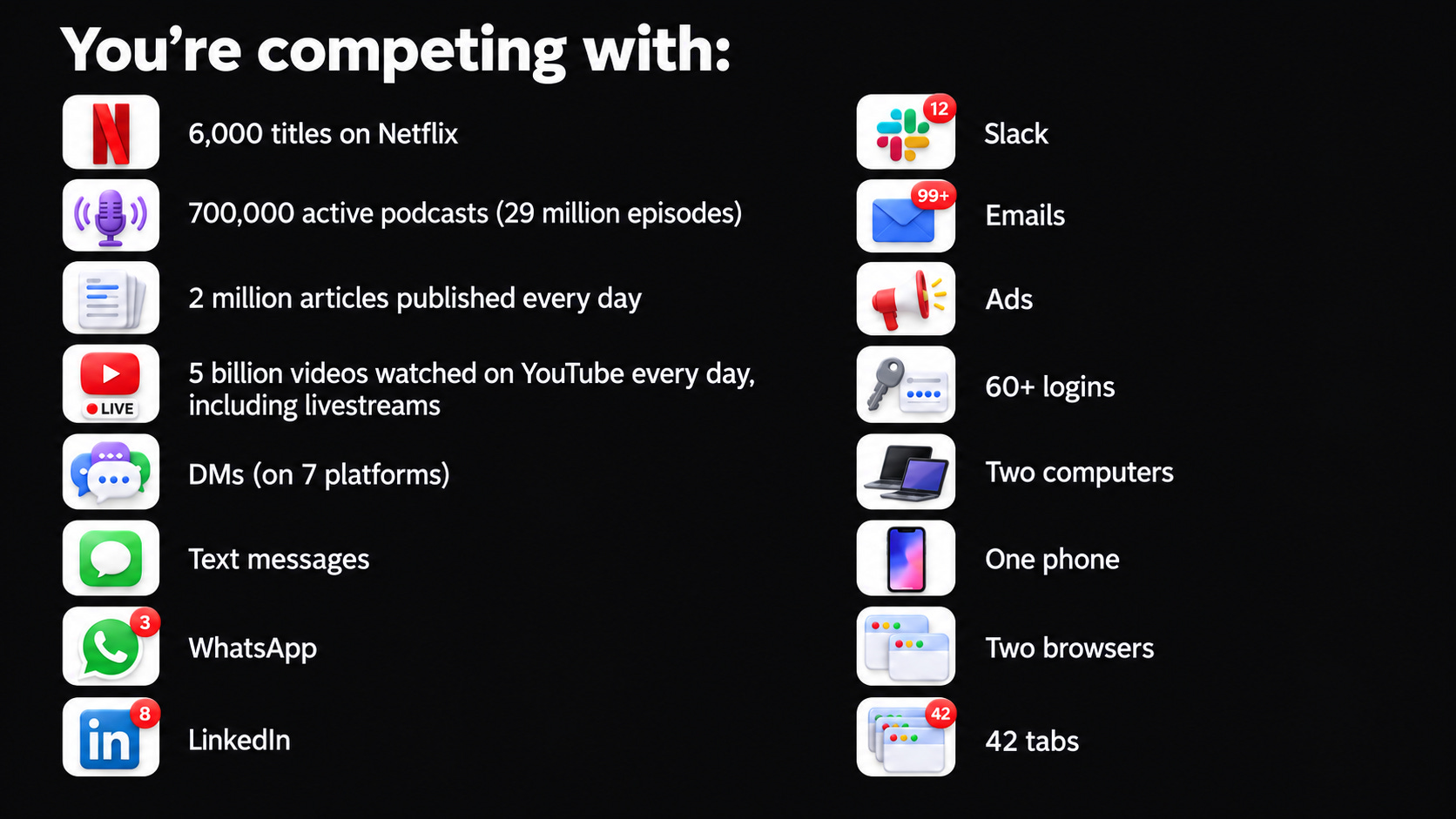
That’s the market you’re competing in.
So understand what a sale actually is. The market pays you with their attention.
It’s not when someone fills out a contact form. It’s not when someone pulls out a credit card. It’s when they choose to spend their most valuable resource on you instead of something else.
And every single thing on that list above is more entertaining than what you’re trying to tell them. That’s the harsh part.
Netflix worked this out years ago
They’ve said their biggest competitor isn’t Disney+.
It’s sleep.
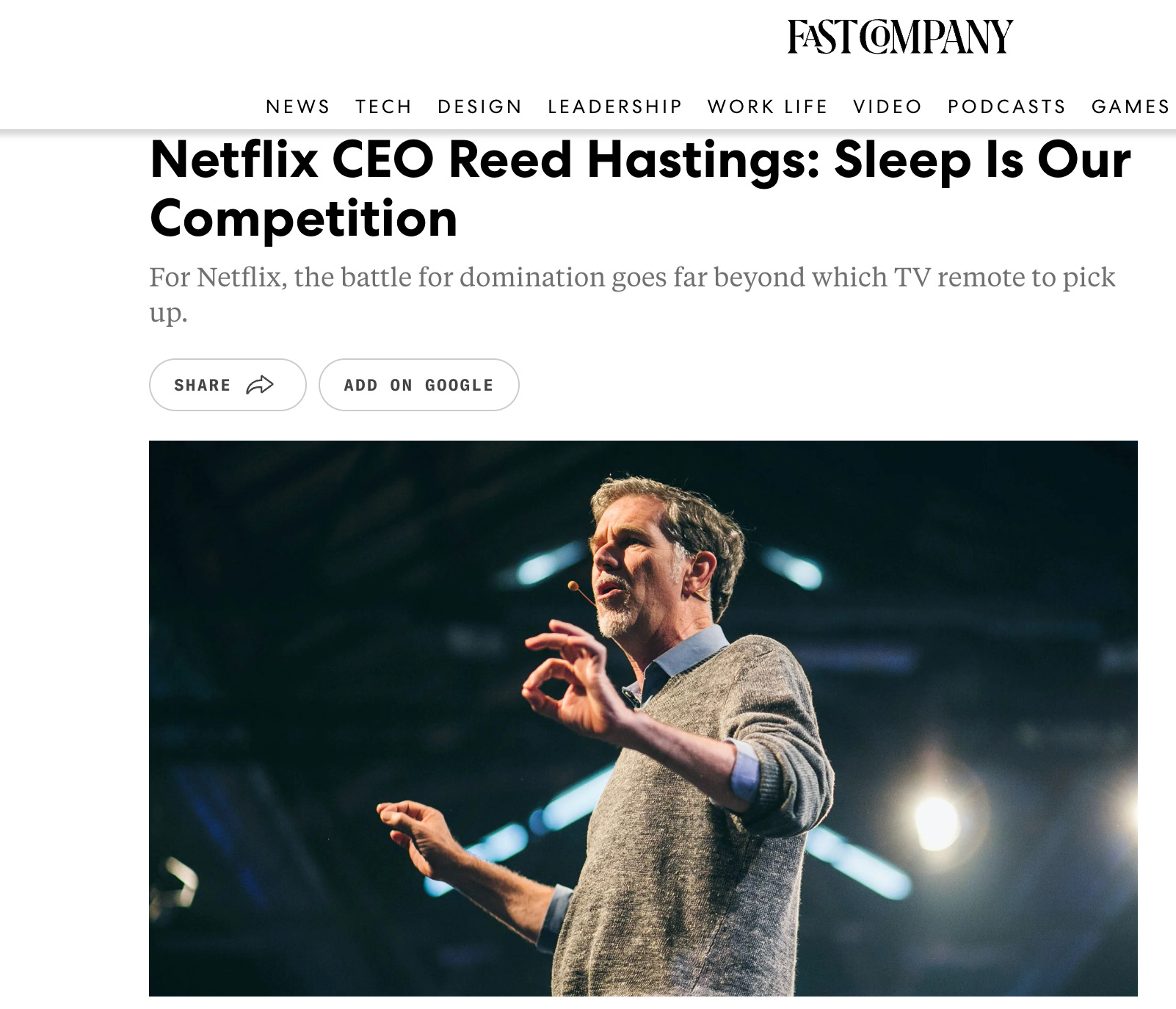
That’s why they test relentlessly. Different thumbnails for the same show, for different people. Nudges about things you’ve already watched. All of it designed to win a few more minutes against the alternative of you closing the laptop.
Everything competes with everything in one enormous arena. And when you step into it, you’re asking your prospect to choose you over all of it.
Which is why it’s not enough to know what your competitors are doing. You need to know where your prospects actually spend their time. What are they watching? What are they listening to? What do they scroll past without thinking?
You need to be a student of markets, not a student of your category.
Day trading attention
So let’s talk about what you’re actually running.
A sales funnel is simply a system with inputs and outputs.
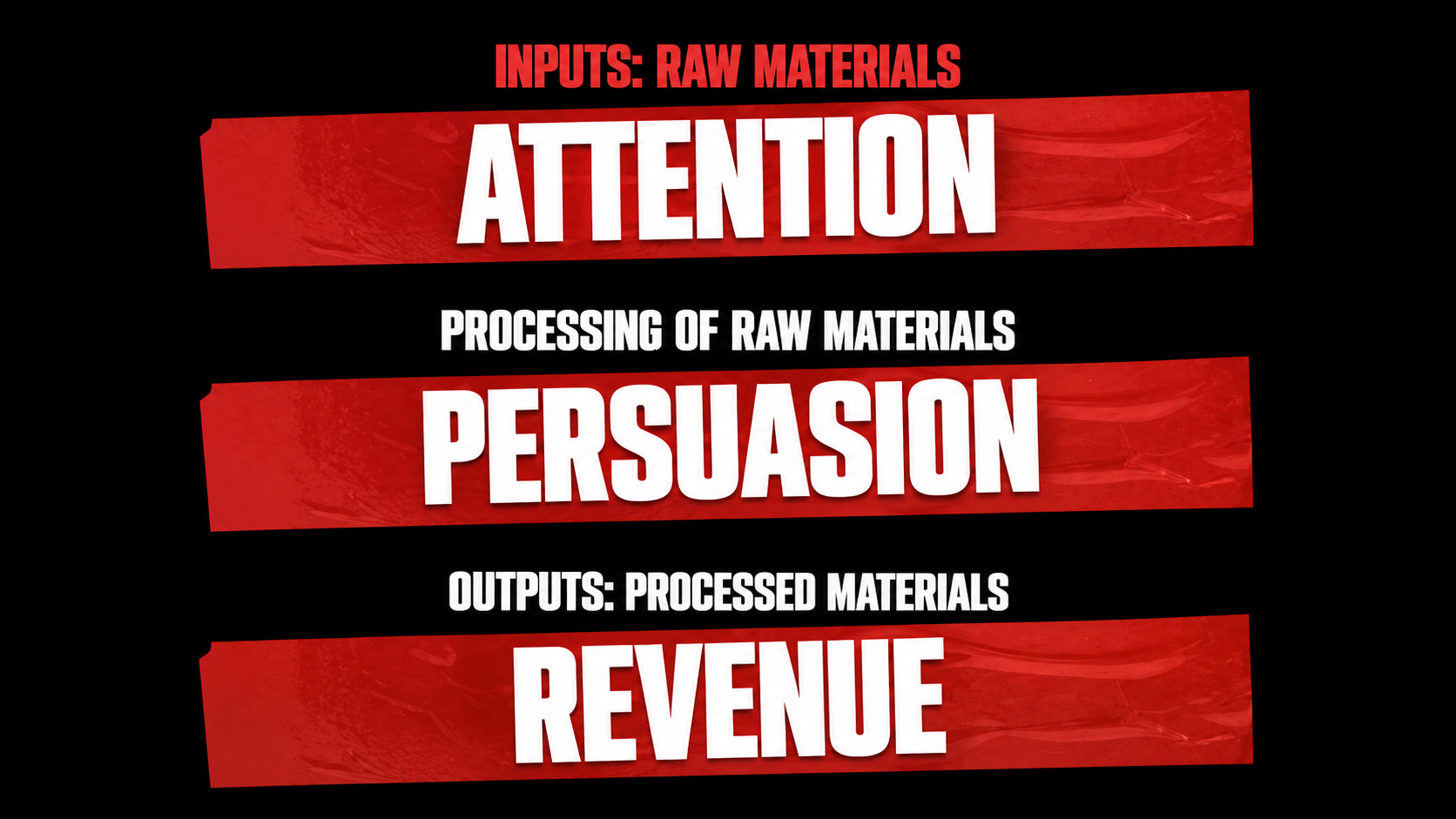
The raw material is attention.
The processing of that raw material is persuasion.
The output is revenue, whether that looks like leads or sales or whatever it is for your business.
Regardless of what you’re selling, this stays true. You have to get attention first. Nothing happens until you hijack it.
Once you understand that, the game becomes: how do you hack that system to get more attention and more throughput?
Not just attention at the top end. Throughput through the whole funnel.
You do it by getting leverage.
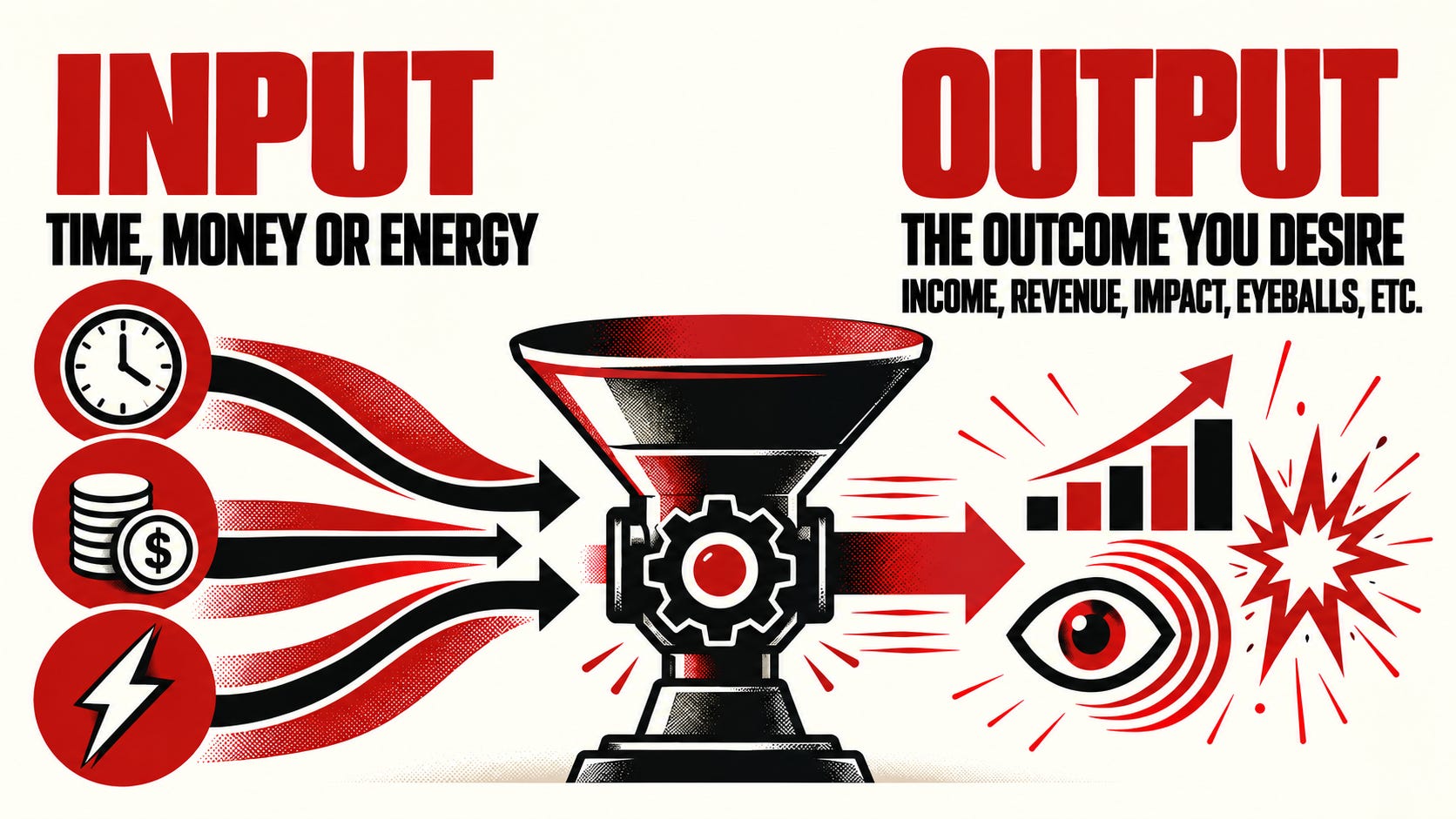
The inputs are the time, money and energy you put into the system. The output is whatever outcome you’re after.
In a world where the cost of that traffic only goes up, the businesses that win are the ones that get the most leverage from the same traffic.
Because you’re competing with Coca-Cola. You’re competing with every brand out there. There’s only one newsfeed.
So: is this entertaining?
Go and look at every sales message you’re putting out. Email flows. Website copy. The thank-you page nobody reads.
Ask one question about each of them: is this entertaining?
Because that’s what you’re up against. Hyper-personalised content, algorithmically tuned, delivering dopamine to your target market on a schedule.
The first thing to consider is always the same. Why would my prospect even care about what I’m saying?
It has to be interesting. It has to be entertaining. And it has to provide real value, because skepticism is at an all-time high. There is a lot of clutter.
Your prospects have been burned. They doubt everything you say by default. And it’s getting worse as more people come online.

That makes every step of the funnel harder. Getting the click. Getting the opt-in. Getting them to watch the video. Getting them to book.
Because chances are they’ve already been through someone else’s funnel and got nothing out of it.
The second transaction
The way you beat that is a high-value content offer.
A lead magnet. A free report, a checklist, a template, something they get in exchange for an email.
And most people say the same thing: I tried that, it didn’t work.
Here’s why it didn’t.
This is the second transaction. The first was their attention. The second is when you give them something for free, and what you give them has to be as good as a paid product.
Most lead magnets aren’t. Most lead magnets are a stodgy white paper that tells people how great the company is. That’s promotional merchandise with a form in front of it. That’s not value.
Here’s the test: would anyone pay for this?
If the honest answer is no, you don’t have a lead magnet. You have a brochure.
I’ve run a lot of these across different markets. Videos, webinars, low-ticket products, free reports. Split-tested properly.
The free report consistently gives the cheapest cost per qualified lead.
Because don’t forget, in any given market, only 3% are ready to buy right now
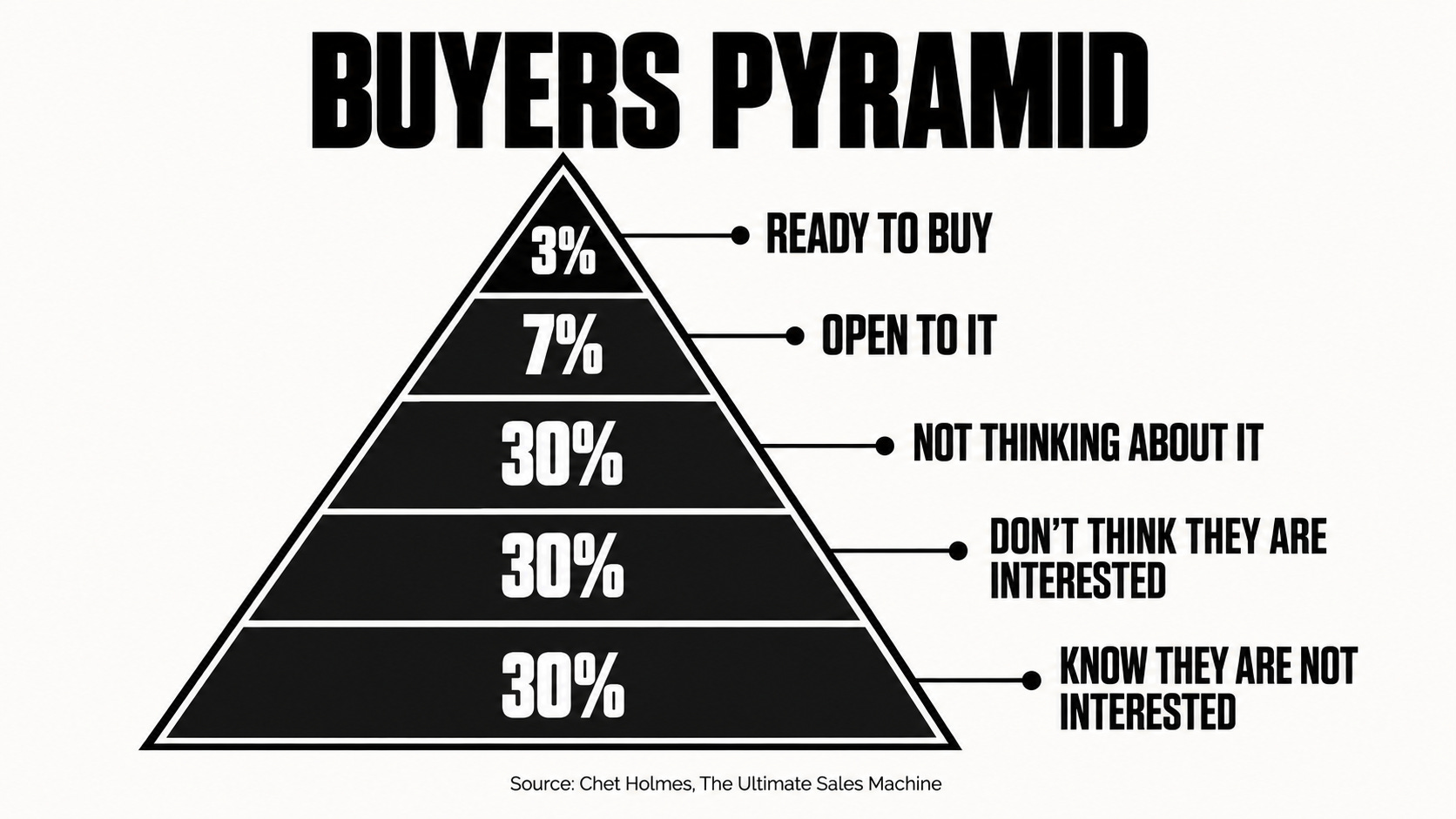
Getting people to opt in and warm them up the pyramid above, using different touch points such as email nurture, is the way to go in terms of combating and converting scepticism.
How I built mine in an afternoon
Here’s the part that stops people. They think this takes two weeks, so they never start.
It doesn’t. Here’s exactly how I made my last two.
The first was a checklist on creating ad creatives 10x faster. The second was a checklist on using AI to make ads that don’t read as AI slop, by mixing AI and human finishing to produce ads at scale.
Step one: find out what people are actually frustrated about.
Not what you think they need. What they’re complaining about, in the words they’re complaining in.
If you already know people’s pain and issues, you can skip step one, but here’s exactly what I did:
I use Reddit Answers, which is more direct than digging through threads yourself.
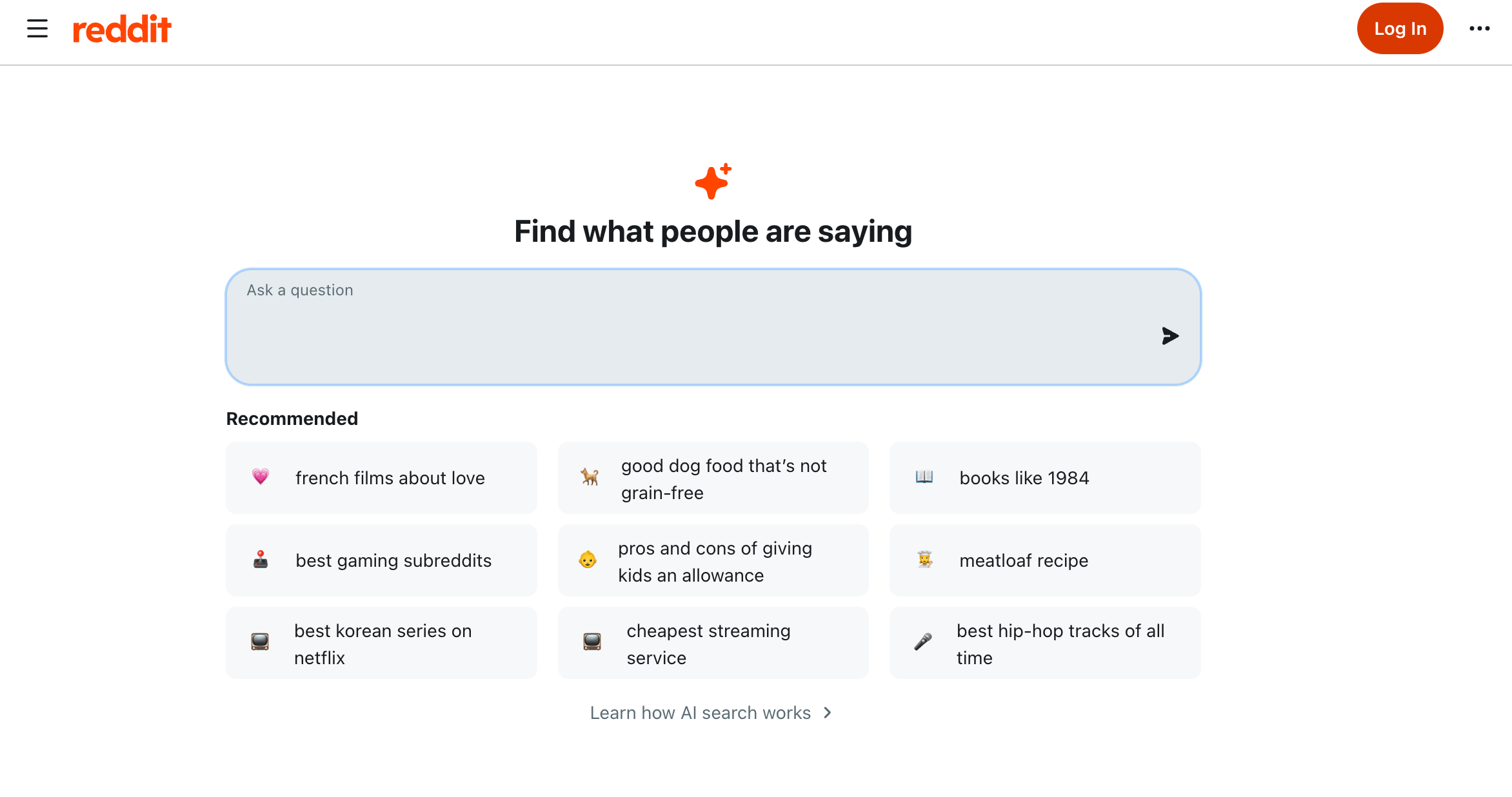
And I run automated Grok tasks pulling from X, so problems people are posting about surface without me going looking. X is social media, so you’re getting real time problems, alerts, and updates from Grok ahead of tools like Google Trends, which takes a while to catch up.
What came back was consistent. Marketers are stressed about two things: not getting results, and running out of creative ideas when they’re trying to scale traffic and get clicks.
So that’s what the checklist answered.
Not what I wanted to talk about.
What they were already annoyed about.
Step two: talk it, don’t type it.
I use Wispr Flow for almost everything I write, and this was no different. I dictated the whole thing.
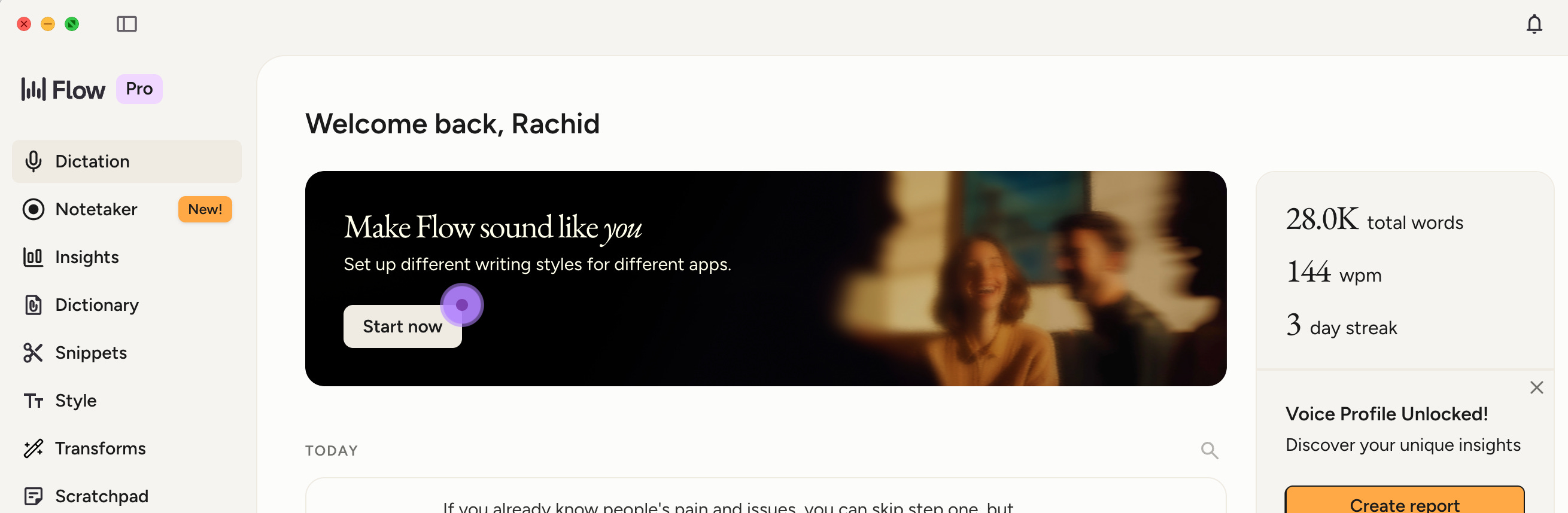
Talking is about ten times faster than typing, and more importantly it sounds like you. You already know this material. You’ve explained it out loud dozens of times. So explain it out loud again and capture it.
Step three: build the corpus.
This is the bit most people skip.
I collected everything good I’d seen on the topic. Newsletters, articles, LinkedIn posts, X threads, plus screenshots of strong ebooks and ads from the LinkedIn and Meta Ad Libraries.
Then I uploaded the lot to an LLM and asked it to reverse engineer the patterns and give me the best possible prompts.
Same move as last week’s ad research, pointed at a different target. The proof of what works is already public.
Step four: add your own evidence, and weight it heaviest.
Then I uploaded my own material. Notes from past work, screenshots of campaigns that worked, things out of my Drive I’d never done anything with.
This is the step that makes it yours rather than a summary of the internet. Anyone can collate. Your own results are the thing nobody else has.
Step five: finish it yourself.
AI is for starting projects. Humans are for finishing them.
I gave the transcript and the corpus to Claude to clean up and structure. Not to write it. The thinking was already done.
One rule on the collating, while we’re here: if a concept came from someone specific, name them. Chet Holmes’ buyer pyramid is Chet Holmes’ buyer pyramid. Crediting people costs you nothing; it makes you look well read, and the people you credit tend to notice.
When it comes to the material/resoruce itself, I tend to play around with different tools and have them fight against each other.
For example, I got Claude to do the whole checklist pages, but I got Gemini to do the cover. It seems to do better illustrations for the cover.
Tip - Get in the habit of comparing tools and LLMs to do different variations when it comes to creative. I also use tools outside of standard LLMs, like Gamma.ai and higgsfield.ai.
That’s my checklist, and what worked for me.
Dictate, research, collate, add your own, finish by hand. An afternoon, not a fortnight.
And the reason it works isn’t the tooling. It’s step one. The content answered a problem people were already complaining about, in the language they were complaining in.
Value is the antidote to skepticism
That’s the lens I want you to look through:
How can I provide the most value to my market for free, and treat them like customers before they give me a cent?
That’s how you fight the skepticism that’s running wild right now. Not by being more persuasive. By being more useful than anyone would expect from something free.
Make the sale easy
Marketing’s job is to make sales easy.
You should be building so much desire in your marketplace that people are already sold before you ask them to buy.
Think about the Apple Store. The staff are order takers. Nobody in there is being sold to, because the selling happened long before anyone walked through the door.
Your job is to articulate the pain points, show how your product solves them, and present an offer that’s unlike anything they’ve seen.
And if you’re answering the same objection over and over, that’s not a sales problem. Your marketing isn’t strong enough yet. Handle the objections upstream so the conversation at the bottom is easy.
Don’t ask someone to buy until they’re already sold.
I learned all of this the slow way. I had a bad case of shiny object syndrome early on and got my ass handed to me, because I kept jumping from thing to thing.
Things only started working when I focused on the main thing:
Understand your prospect’s problem better than anyone else. Articulate it better than anyone else. Solve it better than anyone else.
That’s it. That’s the whole job.
Till next time✌️
